Saturday, 13 October 2012
An American on English Canals.
When I first started collecting books the process could be long, tedious and arduous. Browsing in second-hand & antiquarian bookshops occasionally yielded results or having found a bookshop that specialized in Transport books and asked for their current catalogue ,one occasionally found a few old canal items there. You could of course advertise for a particular title in ‘Bookdealer’ a trade weekly with ‘Books wanted’ and ‘Books for Sale’ categories.
With the arrival of the internet nothing less than a revolution took place and later still internet auctions made everything so much easier.
With the internet; bookdealers could advertise any individual book for sale through such sites as – Abe books, biblio, Alibris ,amazon and eBay.
All auctioneers could show details & complete catalogues of their sales on line and one could bid online too.
‘Bookfinder’ is however by far the best site for searching for old,used and antiquarian books since it collates all the books for sale in such sites as Abe or amazon etc. under one roof. Thus millions of books for sale by thousands of bookdealers around the world can be found instantly.
The search facility allows one to search by author or title with advance searches for first editions, any language etc. The results of a search will yield a list of bookdealers around the world with that book for sale complete with postage costs to your country. It is quite simply the best.hBookFinder.co


Wednesday, 11 April 2012
Pickfords & Braunston (Canal Bill of Exchange).

With current news headlines in mind I thought readers of this blog might like to see an early example of a form of tax avoidance which only goes to prove that there is really nothing new under the sun.
Printed on incredibly thin hand made paper and now rather fragile this document was issued at Braunston 10 years after the Grand Junction Canal had opened as a through route to London.
Pickfords (Today still carrying by road) were at this time major users of the canal and had offices ,warehouses and wharves at Braunston.
Canal Bills of Exchange were bank drafts issued by a shipper for general services or goods. At this time shortly after the Napoleonic Wars,gold was scarce and it was not uncommon to make payments by bankers draft. However in order to avoid government revenue payable on their own drafts ,payees often endorsed the bills of exchange they had received on the reverse and used them to make further payments.
So turning the bill over…….

The signatures of Richard Vann, William Alcock, T S Marriott, William Whittles, Jones & Mann, Thomas Whalley & Sons , James Mitchell And Richard Williams have been endorsed on the rear of the draft.
The draft issued in 1815 by Pickfords at Braunston was for the not inconsiderable sum of £72 11s 1d and was made out to Richard Vann.
Vann is an unusual surname and I wonder if any of his descendants (or any other of the endorsers of the document) are living in the Braunston area today.
Saturday, 31 March 2012
Children on Englands Canals (1947)

With the recent announcement of the demise of the Encyclopaedia Britannica in printed form (It will be available on line); I was reminded of a seemingly inauspicious item in my collection which at first glance might be passed over as ‘just another childrens book’
As a 1947 American publication by the Encyclopaedia Brittanica it is not often seen here in the UK and was I think not issued here, being primarily intended for children in the U S.

With over 40 photographs of boat life on boats of the Grand Union Canal Carrying Companies fleet, this book is a ‘must see’ for anyone interested in social history on Britain’s canals.

The photographs – mainly of kids on the boats, also show boats at work including some unusual shots of wide beam boats on the southern Grand Union.

Very interestingly, the title page describes the illustrations as being taken from the Encyclopaedia Brittanica film ‘The Canals of England’. Has anyone ever seen this film? I cant remember coming across it before.


As you can see many of the shots are quite unusual in their scope and seem to have been taken on the G Union between Bulls Bridge layby and Stoke Bruerne.

If you know anything about the film please let me know.
Sunday, 11 March 2012
‘Canals are Coming Back’
Forgotten pictures from 70 years ago. 
This well known and popular photo illustrated weekly magazine ran from the mid 1930’s until the mid 1950’s.
Two weeks after the war began in September 1939 the magazine – Picture Post ran a 7 page article on the state of Britain's canals. The article briefly surveyed the past and present state of canal trade here and contrasted this with the conditions found on the continent. The emphasis was placed on the ‘family nature’ of canal carrying and a Picture Post photographer was sent to record the conditions in which the ‘bargees’ lived and worked.
The resulting article with its intimate shots of family life on the boats of the Grand Union Canal Carrying Co makes for interesting viewing today. The views of the boat children helping with boat & lock work are especially valuable, since they are an aspect of boat life often overlooked & are precursors of the wonderful photography of Robert Longdon a little later (His work can be seen in Sonia Rolt’s book A Canal People).


The timing of the publication of this article was quite important and was probably prompted by the publication of the Committee of Imperial Defence’s report on the usefulness of British canals in wartime.

For those in 1939 however, this was not just a cosy article on the boatpeople's life but was a reminder of the strategic role that canals and transport generally were to play in the coming struggle.
There is also one of the earliest mentions of what was to become the Ministry of Labours training scheme for new ‘bargees’ as the magazine kept calling them.


There are over 20 evocative photographs taken mostly on the boats of the GUCC’s fleet in and around London.
Monday, 13 February 2012
The first Englishman to sail across Europe?
Those of you who read my blog of Nov 2110 – Isabel and the Sea may remember that its author George Millar was a recognized WW2 war hero who after the war sailed his boat across France and into the Mediterranean.
I mention this only because Merlin Minshall the subject of this present blog seems to share some of the same characteristics as Millar. They both for example set off on their voyages from Southampton,both had exciting and adventurous war careers and above all they were both ,that very rare thing today ,larger than life characters with a strong sense of individualism and self reliance.
Apart from his epic voyage across Europe Merlin Minshall’s chief claim to fame and the one by which he his more popularly remembered is that he was the inspiration for the character of James Bond the fictional spy created by the author Ian Fleming.

Merlin Minshalls autobiography. 1st Edition published in 1975.
The son of a wealthy newspaper owner and educated at Charterhouse and Oxford University, Minshall soon tired of his initial career as a trainee architect and in 1932 after reading a magazine article about ‘Water Gipsies’, decided to buy a boat and explore the waterways of Europe. Sperwer was a small motorised Tjalk Boeier,10 tons and 27ft on the waterline and with her 1000sq ft of sailing gear still intact when the author found her. So together with his first wife Minshall set off on what was to become a legendary and unique voyage in more ways than one.

Minshall intended to take his boat right across Europe by way of the Seine,Marne Rhine Canal,R Rhine, Ludwig's Canal (still just navigable at this time) and then to voyage the whole length of the Danube to the Black Sea. This trip had been accomplished many years before in an English boat with an American crew and the results published in book form as Across Europe in a Motor Boat by Henry C Rowland.
Title page of Across Europe in a Motor Boat. 1st Ed 1907.
Rowland’s boat the Beaver had been built especially for the trip which followed almost exactly the route to be taken 30 years later by Minshall with the Sperwer. They had intended a round trip of over 7,000 miles returning from the Black Sea via the Mediterranean and the Canal du Midi across France but a storm in the Black Sea wrecked the boat and put paid to that idea.
Literary accounts of travel down the Danube are in fact quite common and for some unaccountable reason the authors are usually Americans.Longer trips across Europe are much more rarely described.Negley Farson (another American) did one such trip in 1926 His book Sailing Across Europe describes a journey with a departure point in Holland. The accolade for pioneering trips by Englishmen must surely go to Donald Maxwell who took his boat Walrus from a Dutch port to the Black Sea in 1906 the voyage was published in book form as A Cruise Across Europe.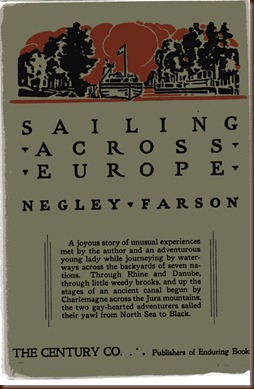 First Ed 1926

English Author Donald Maxwell's book of 1906.
Merlin Minshall’s journey of over 4,000 miles on Sperwer in fact took 2 years to accomplish and the result was published in the National Geographic Magazine in May 1937. At a time of rising tensions in Europe and the 2nd World War imminent, the journey was naturally and to say the least very adventurous. It is an almost unbelievable account of meetings with the top Nazi Goering, of seduction by a glamorous German Counter Intelligence spy and his subsequent entrapment in a Nazi spy ring. Interestingly the 16 page article in the National Geographic omits all the above excitement and just deals with a factual account of the voyage .This article is, as, as you would expect for the N G magazine profusely illustrated with photos of the voyage.
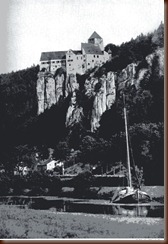
Two photographs from the National Geographic Mag showing Sperwer in the Ludwigs Canal. One of the smallest Continental canals.

Map inside cover of ‘Guilt Edged’ 1975
Minshall’s accounts of his exploits with women including the glamorous German spy would lead one to believe that he was the possessor of a huge ego and that he was almost certainly guilty of exaggerating events that had occurred during his life especially in retrospect and in preparation for his autobiography Guilt Edged published in 1975.
Subsequently he became a member of the Royal Navy’s Intelligence Division and during WW2 ran Operation Shamrock which monitored German U Boat traffic in the Gironde estuary and later fought with Tito’s partisans in Yugoslavia as a member of the Allied Naval Mission.
Ian Fleming the creator of James Bond had Minshall taken on by British Naval Intelligence who promptly sent him back to the Danube to investigate the possibilities of blocking this route for German Oil Barges. Later he was said to be the first secret agent to be sent to France by submarine. He was closely involved with both the Bismarck and Graf Spee actions and the Japanese whilst he was with the Royal New Zealand Navy. With al this glamorous and exciting clandestine activity it is little wonder that Fleming based his James Bond character on Merlin Minshall.
Guilt Edged is an unusual book full of daring do as is Isobel and the Sea. For me the latter book has the edge being a factual and sober account of a journey by boat across a Europe ravaged by war. However if glamour and excitement is your thing then Minshall may be your man. Both books are available inexpensively as paperbacks but if you want a first edition of Guilt Edged be prepared for a quite expensive purchase as Minshall’s connection with Fleming and his identification as the real James Bond has meant that his autobiography is well sought after by collectors of Ian Fleming and James Bond artefacts,books and ephemera.
Incidentally the 100 year old Sperwer finally found a home in the Dutch National Maritime museum at Einkhouzen in 1975.
If you missed my blog on George Millar's book Isabel and the Sea I am republishing it to follow this present blog.
I mention this only because Merlin Minshall the subject of this present blog seems to share some of the same characteristics as Millar. They both for example set off on their voyages from Southampton,both had exciting and adventurous war careers and above all they were both ,that very rare thing today ,larger than life characters with a strong sense of individualism and self reliance.
Apart from his epic voyage across Europe Merlin Minshall’s chief claim to fame and the one by which he his more popularly remembered is that he was the inspiration for the character of James Bond the fictional spy created by the author Ian Fleming.

Merlin Minshalls autobiography. 1st Edition published in 1975.
The son of a wealthy newspaper owner and educated at Charterhouse and Oxford University, Minshall soon tired of his initial career as a trainee architect and in 1932 after reading a magazine article about ‘Water Gipsies’, decided to buy a boat and explore the waterways of Europe. Sperwer was a small motorised Tjalk Boeier,10 tons and 27ft on the waterline and with her 1000sq ft of sailing gear still intact when the author found her. So together with his first wife Minshall set off on what was to become a legendary and unique voyage in more ways than one.

Minshall intended to take his boat right across Europe by way of the Seine,Marne Rhine Canal,R Rhine, Ludwig's Canal (still just navigable at this time) and then to voyage the whole length of the Danube to the Black Sea. This trip had been accomplished many years before in an English boat with an American crew and the results published in book form as Across Europe in a Motor Boat by Henry C Rowland.

Title page of Across Europe in a Motor Boat. 1st Ed 1907.
Rowland’s boat the Beaver had been built especially for the trip which followed almost exactly the route to be taken 30 years later by Minshall with the Sperwer. They had intended a round trip of over 7,000 miles returning from the Black Sea via the Mediterranean and the Canal du Midi across France but a storm in the Black Sea wrecked the boat and put paid to that idea.
Literary accounts of travel down the Danube are in fact quite common and for some unaccountable reason the authors are usually Americans.Longer trips across Europe are much more rarely described.Negley Farson (another American) did one such trip in 1926 His book Sailing Across Europe describes a journey with a departure point in Holland. The accolade for pioneering trips by Englishmen must surely go to Donald Maxwell who took his boat Walrus from a Dutch port to the Black Sea in 1906 the voyage was published in book form as A Cruise Across Europe.
 First Ed 1926

English Author Donald Maxwell's book of 1906.
Merlin Minshall’s journey of over 4,000 miles on Sperwer in fact took 2 years to accomplish and the result was published in the National Geographic Magazine in May 1937. At a time of rising tensions in Europe and the 2nd World War imminent, the journey was naturally and to say the least very adventurous. It is an almost unbelievable account of meetings with the top Nazi Goering, of seduction by a glamorous German Counter Intelligence spy and his subsequent entrapment in a Nazi spy ring. Interestingly the 16 page article in the National Geographic omits all the above excitement and just deals with a factual account of the voyage .This article is, as, as you would expect for the N G magazine profusely illustrated with photos of the voyage.

Two photographs from the National Geographic Mag showing Sperwer in the Ludwigs Canal. One of the smallest Continental canals.


Map inside cover of ‘Guilt Edged’ 1975
Minshall’s accounts of his exploits with women including the glamorous German spy would lead one to believe that he was the possessor of a huge ego and that he was almost certainly guilty of exaggerating events that had occurred during his life especially in retrospect and in preparation for his autobiography Guilt Edged published in 1975.
Subsequently he became a member of the Royal Navy’s Intelligence Division and during WW2 ran Operation Shamrock which monitored German U Boat traffic in the Gironde estuary and later fought with Tito’s partisans in Yugoslavia as a member of the Allied Naval Mission.
Ian Fleming the creator of James Bond had Minshall taken on by British Naval Intelligence who promptly sent him back to the Danube to investigate the possibilities of blocking this route for German Oil Barges. Later he was said to be the first secret agent to be sent to France by submarine. He was closely involved with both the Bismarck and Graf Spee actions and the Japanese whilst he was with the Royal New Zealand Navy. With al this glamorous and exciting clandestine activity it is little wonder that Fleming based his James Bond character on Merlin Minshall.
Guilt Edged is an unusual book full of daring do as is Isobel and the Sea. For me the latter book has the edge being a factual and sober account of a journey by boat across a Europe ravaged by war. However if glamour and excitement is your thing then Minshall may be your man. Both books are available inexpensively as paperbacks but if you want a first edition of Guilt Edged be prepared for a quite expensive purchase as Minshall’s connection with Fleming and his identification as the real James Bond has meant that his autobiography is well sought after by collectors of Ian Fleming and James Bond artefacts,books and ephemera.
Incidentally the 100 year old Sperwer finally found a home in the Dutch National Maritime museum at Einkhouzen in 1975.
If you missed my blog on George Millar's book Isabel and the Sea I am republishing it to follow this present blog.
Saturday, 11 February 2012
‘Isabel and the Sea’ by George Millar. (1948)

Publisher- Century 1983.
A few years ago whilst selling books at a book fair in Penzance', I was approached by an obviously nautical ‘character’ and asked if I had a copy of Isabel & the Sea for sale. I had never heard of the book but eventually managed to find him a copy. The guy told me that he lived in Penzance during the winter and spent his summers exploring the Mediterranean in his boat after having sailed it over from England and down through the French waterways. He wanted a copy of Millar's book because the author had made the same journey through the French canals many years before but in vastly different circumstances. It was ,he said, ‘ one of the most entertaining accounts of travel through the French canals ever published’. My interests were aroused and I was not disappointed.
I suppose the unique character of the book lies in the extraordinary circumstances in which the journey took place, for Millar’s canal trip took place in the immediate aftermath of war torn Europe. There is as far as I know, no other book remotely like it. It seems to have everything – excitement, adventure and social reportage being just three elements in a book written by an acknowledged war hero.
The author had just published his war memoirs when at the age of 35 and in 1946 he bought an old Cornish lugger with the proceeds from the sale of his book. In June 1946 after some initial fitting out difficulties in the continuing wartime conditions of rationing and emergency laws he set sail for France with his wife who knew nothing about boats and suffered from constant sea sickness. He himself had sailed dinghy's as a child and had taught himself navigation whilst a prisoner of the Germans during the war.
Provisioning of the boat was accomplished with a cooked chicken, 6 lbs of strawberries and many cartons of cigarettes which they intended to barter for food on their journey.
Millar’s boat must have been one of the first boats to attempt a journey through the French waterways after the war. The conditions were appalling! They made Le Havre safely only to find the harbour full of sunken wrecks and only a handful of houses left standing in the town. On their canal journey they were shocked by the half gutted villages and the general privations of the population. The book abounds with conversations with the locals and especially the working boat community. Common topics were the food shortages and the black market. Passing through the Canal de Loing, Briare , Loire lateral and Canal du Centre canals they were surprised at the amount of horse drawn boat traffic they encountered. Evidently this was as a result of the German requisitioning of all the ‘automoteurs’ during the war.
Encountering barges full of German prisoners he comments that the prisoners were not being treated very well by the French, in marked contrast to the treatment afforded to the prisoners in American hands they saw at Le Havre. Not unsurprising one would have thought considering the devastated landscape through which they were passing.
Difficulties in obtaining supplies,spare parts and fuel are all discussed in some detail. They visit famous people of the time including Somerset Maugham and Lord Beaverbrook. Millar is called to Paris for presentation of a war medal by General de Gaulle. On their arrival in Marseille they progress into the Med where ports of call include Antibes and San Remo. Every harbour is found bomb blasted and littered with wrecks. The journey through the canals occupies a large part of the book before they journey onto Italy and beyond.One little incident serves to inform us of the constant reminders they had of the all too recent war. The wine that accompanies their meal in an Italian restaurant ‘comes with the compliments of the Wehrmacht’ their Italian waiter informs them with a wink.
Throughout the book the author gives occasional hints of his involvement in the war. When I researched further I found that he was in fact a well decorated war hero.George Millar was a journalist living and working in Paris before the war. On the outbreak of war he returned to England and enlisted. He was captured in North Africa and sent to Italy. When Italy surrendered he was sent by the Germans to a POW camp in Germany and it was on this journey that he jumped from a train and started back across France where he encountered a POW escape line to Spain. After much hardship and many adventures he made it back to Britain where he was promptly enrolled as a secret agent and parachuted back into France. All of these exploits are described in his two books ‘Maquis’ and ‘Horned Pigeon’. For a fuller account of his life go to www.independent.co.uk/news/obituariesAfter the war he farmed in Dorset, sailed and wrote more books about his sailing adventures.
In the 1948 edition ,’Isabel and the Sea has a photograph of the Lugger as a frontispiece but no other illustrations.The book was reprinted by Century in 1983 as an unillustrated paperback.After the authors death in 2006 the Dovecote press published a hardback edition with 4 pages of photographs found at P Millar's home.
A really great read.
Friday, 16 December 2011
A Merry Christmas to all.
Compliments of the season to everyone and a quick blog. I have not been able to ramble on about my books since the summer as I sold my beloved boat in July and my collections had to go into storage. Life has been pretty hectic since then and I have been mainly preoccupied with finding somewhere to live. I have at last found a tiny secluded cottage not too far from family and friends and still in the countryside. I move my books in sometime in the new year.
I will miss the ‘cut’ but compensations include having a garden and a bit more space. I can still boat as all my 3 kids have boats so its not too bad.
October was an eventful month as I journeyed to Holland to bring back a Dutch ‘Tjalk’ which my youngest son had just bought. A really great trip from Utrecht down the Lek and Maas and estuaries to Stellandam and from there out into the North Sea and an adventurous trip down the Dutch and Belgium coasts in beautiful October sunshine. Off Dunkirk we turned to make the crossing to Ramsgate but bad weather after a couple of hours forced us to retreat and seek shelter at Calais which after battling some really rough seas all night we finally made at 5am in the morning.We had really left it too late in the year for any continuous spells of good weather so we had to leave the boat at Calais for a couple of weeks before a day produced calm enough seas for the boat to finally complete her trip to ‘Blighty’.
Again Best Wishes for Christmas & the New Year to everyone and to anyone who enjoys reading my stuff you can look forward to more of it sometime in the New Year!
Friday, 1 July 2011
Croggans Roofing Asphalt. (Engraving of the week)

‘Camping out’ from –Life on the Upper Thames by H R Robinson. 1875
Robinson and his companions had some dire views on the virtues of camping out alongside the river and much preferred wherever possible to stay in riverside inns. He says…..’The risk of rheumatism and concomitant evils is, in our opinion too serious to be encountered for a whim….’
Whilst acknowledging that ‘….when the days are at their longest and the moon is full, then, indeed, if the weather should be perfectly fine, we will grant that the river is most beautiful after sunset. To take a boat then, and lazily drop down the river, listening to the measured splash of the oars, has given us a sense of tranquil enjoyment , in its way unrivalled.’ However the merits of camping out amongst all this beauty are not even to be considered unless ‘…especial attention is paid to the selection of a suitable piece of land (that on a slight incline is preferable), but, above all, the exclusion of damp, the forerunner of acute rheumatism, should be carefully studied. A most terrible result may arise if this be not carefully attended to.’
The author also recommends ‘…a plentiful supply of travelling rugs for coverings…’ as otherwise ‘….without plentiful covering, the (tents) occupants would possibly receive a chill that might be productive of evil results’.
The answer to all these dire warnings was of course ‘Croggan’s Roofing Asphalt’ , which it would would appear should be an indispensable part of any riverside campers kit. For ‘….although rather large in bulk, is very light, and forms, when laid down, a most comfortable substitute for a mattress, and is thoroughly waterproof.’
So the next time you encounter riverside campers carrying rolls of roofing felt along the tow path you will know that Robinsons words of wisdom are still being adhered to even today 135 years later. However a word of warning for those of you intending to try a little incautious camping for yourselves - You may be tempted to evade the carriage of the said felt to your chosen camping site, so you should be reminded that substitutes will not do for ‘…the ordinary mackintosh, though smaller in bulk, is not so well suited for the purpose.’
It seems that only Croggan’s will do!!!

Thursday, 23 June 2011
The Water Gipsies. (1930)

The Water Gipsies by A P Herbert. 1930. First edition with its colourful art deco dust wrapper.
There are in fact three works of fiction entitled The Water Gipsies whose contents are based on the English canal system. All three were successful books which interestingly and entirely coincidentally were produced at the very beginning, in the middle of and at the very end of a 100 year period of English Canal Fiction.

‘The Water Gipsies or The Adventures of Tag, Rag & Bobtail’ by L T Meade first appeared as a serialization in an English magazine in 1878 and in fact can boast of being the first work of fiction in England devoted solely to a canal theme. Up to this time canals had only enjoyed brief mentions in novels devoted to other subjects.
Meade’s book was the first of many books to publicise (In the years 1880-1900) , the subject of the moral & social conditions of the canal working population. For more on this book & others see my article at http://canalbookcollector2.blogspot.com
Frontispiece illustration from L T Meade’s – ‘The Water Gipsies’

For a good read of an interesting period piece you could do worse than find one of the innumerable copies of this book which are available and which is really the subject of this article.
A P Herbert's book came out in 1930 and was an immediate hit with the public. It spawned a musical and then a film starring Anne Todd which although like the book –long forgotten, is I am told, possible to see online.
The book tells the story of Jane Bell a working girl in service who dreams of joining ‘the bright young things’ of 1930’s London. From her home on a Spritsail barge on the river somewhere in west London Jane becomes an artists model and finally begins to enjoy the parties,fashion and fun of her dreams. Only after many adventures does she find what the reader has long suspected, that this world is not what it seems and so she finally returns to long suffering boy friend Fred (A boatman on the Grand Union Canal) and finds true happiness as she sails off into the sunset on a working boat.
Set against the contemporary world of the depression years of the 1930’s the book is really a social comment of the times albeit written in a humorous and very readable manner. A comment on the title page describes the book –‘as a sympathetic and intimate study of the lives of poor people’ . A comment that today might raise the eyebrows of those concerned with political correctness, one feels.

Herbert for all that, had his heart in the right place, as he loved the river and portrays it absolutely authentically. He was an MP for many years and a member of the Thames Conservancy and was a very early president of the Inland Waterways Association. He could always be relied on to represent the views of those who loved the waterways and wrote for instance No Boats on the River in 1932, The Thames in 1966 and Singing Swan (About Thames Barges) in 1968.
Water Gipsies. First American Edition 1930.
All the many editions over the years, with Penguin paperback editions appearing in 1960 and 1973, have proved the popularity of this book so do read it if you get a chance.

One last note – If such bibliographic details mean anything to you and you want to acquire the book in first edition form then look out for the tiny printers collation number 330 at the bottom of the last page of adverts at the rear of the book. Such pedantic details are I am sure wearisome to those unafflicted with the book collecting disease but for those sufferers like myself any other number than 330 is not a true first edition (there were several other printings in 1930). Anyway whatever edition you read either one picked up for pennies at a flea market or charity shop or a true first edition with its lovely art deco dust wrapper and signed by the author (Available on the web as I write for £50) I am sure you will enjoy it.

Last and by no means least, and I suspect a lot of canal lovers will have read this one if only because so recently published, Annie Murray’s book which came out in 1992 tells a wartime story of a boatwoman, who after her husband is injured, goes on to run a pair of boats with other women in a manner suggested by the experiences of women in the Grand Junction Canals wartime training scheme.
Sunday, 19 June 2011
Engraving of the week

'Weir with movable bridge' from 'Life on the Upper Thames' 1875. Author –H R Robinson.
Strangely Robinson does not use the term ‘Flash Lock’ in his description of this primitive contrivance for altering the levels of rivers in order to primarily facilitate navigation by boats and barges, although he does describe the operation as ‘flashing a weir’.
I will let Robinson describe the whole procedure …. ‘ The most primitive way of overcoming the difficulty (of shallows obstructing navigation) has been to erect a movable dam all across the river, below the shallow; the boards of the dam,being of course, high enough to keep back sufficient water to enable a boat to float over the shallow. By this means the boat descending the stream meets with no impediment till it reaches the dam or “weir”, (pronounced “wire” by the riverside people. The boards composing the dam are then removed and the boat proceeds with great rapidity, owing to the increased volume of water by which it is carried along. The temporary depth thus produced by the body of water descending enables the boat to descend over many shallows below the weir.
The different parts of the weir are first the cill or fixed beam , laid securely across the bottom of the stream; then, directly over this, but considerately above the surface of the water, is placed a second but movable beam. Against and in front of these parallel beams a set of loose boards is placed upright and close together like a door. These loose boards are called paddles, and the long handles with which they are furnished rest against the upper beam, the pressure of the stream serving to hold them in their places. Between the paddles are placed upright supports termed “rimers;” and when a second set of paddles is employed above the first to obtain a greater depth of water,this set is called the “overfall”.
As the largest barge is far from occupying the fall width of the stream, it is practically found that only a portion of the bridge is required to be movable. In the illustration the man who is putting down the paddles is standing on the movable part called the “swing bridge”. It revolves on a pivot close to the edge of the water and the weight is balanced by the increased thickness of the beam at the landward end on which is often placed a great stone or other heavy substance. The upper beam and hand rail across that part, are of course, removed before the bridge is swung round and it is for this purpose that the two handles which may be noticed are added.........'
The weir in its most primitive form was just a dam and there is evidence that the Vikings dammed the river in order to ease navigation. Later they were used by millers and fisheries and then adapted to the movable type discussed by Robinson to aid navigation.
Many rivers had flash locks and on the Thames ,some lasted into the 20th century –particularly above Oxford where the last at Eaton Hastings survived until 1938.The last surviving capstan used for hauling boats up river against the flow was found at Hurley recently and restored in 1999. Pictures of this and other interesting stuff can be found under locks at http://www.the-river-thames.co.uk
Subscribe to:
Posts (Atom)